Jill Anderson
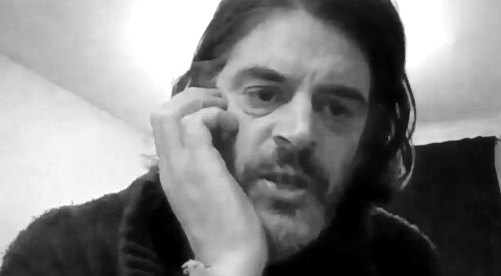
Andy Baxter, who was a critical friend and staunch ally of Asylum magazine, as well as a contributor to the magazine (see Some Catches of the Mental Health System), has died of a sudden cardiac arrest. His premature loss is being keenly felt by his family in Suffolk, his many friends in Lancaster and beyond, and those of us involved in Asylum magazine.
Andy’s life had different phases. Born in Germany in 1969, at RAF Wegberg, Andy attended school in Cambridge, went on to achieve a triple first in physics from Cambridge University, completed a Master’s at Brighton, then moved to Lancaster where he began a PhD which – due to a mental health crisis – he was unable to complete.
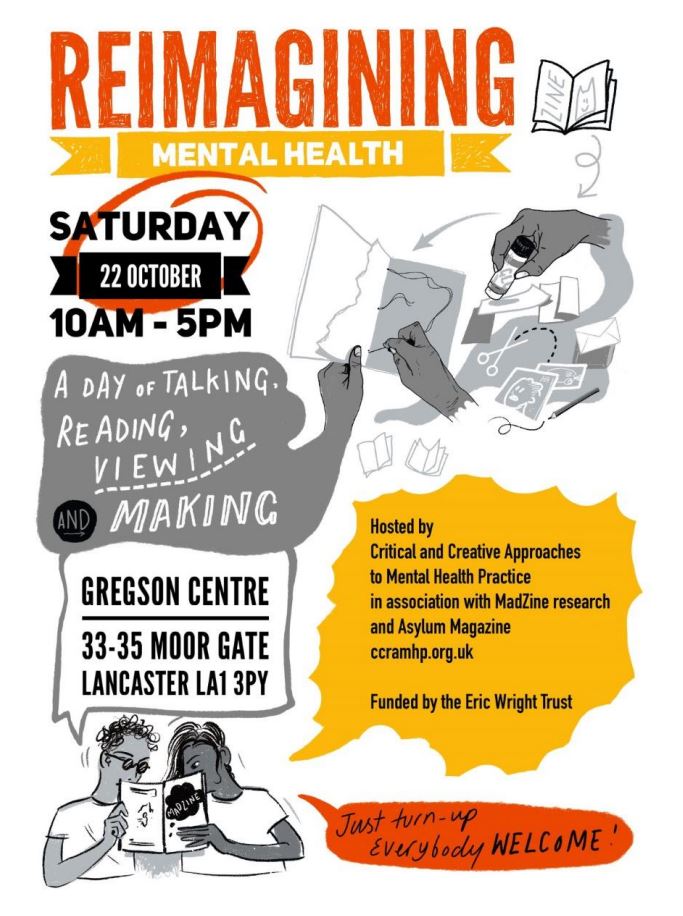
Andy lived in Lancaster for the remainder of his life. He was a member of the Lancaster Makerspace and well known at the Gregson Arts and Community Centre where he was, for many years, a mainstay of the Hearing Voices Group. The image shows a poster he designed for the group.
Andy was a core member of our discussion group, Critical and Creative Approaches to Mental Health Practice (CCrAMHP), where he initiated regular meetings to discuss each new issue of Asylum.
Andy’s brother Charlie recalls that Andy was brilliant at just about everything he turned his hand to: an incredible sailor and rock climber; an absolutely fantastic photographer; perhaps not a musician as such but deeply interested in music, in how it worked and in the maths behind it. Andy built two instruments from scratch, one of which he had invented himself. He was a technical whizz and an excellent coder.
Andy is remembered with great fondness not only by his family but also his many friends: as ‘the kind of person who brought out the best in people and encouraged them to be true to themselves’. Andy was deeply compassionate, with one friend recalling that, when they came out of hospital, the last time they were unwell, Andy was ‘one of the first and only people who was able to find the right words to help me build back my confidence’.
Andy brought that capacity for empathy and understanding to his membership of CCrAMHP, playing a pivotal role in shaping the direction of the group. He regularly came up with ideas for speakers for our meetings, including Vincenzo Passante, who came recently to speak about the mental health system in Trieste.
Andy’s experience of compulsory admission to hospital, over two decades ago, had been traumatic. It is only quite recently, he said, that his life was not dominated by his fear of readmission, and the ‘side’ effects of psychiatric medication continued to affect his quality of life. As a result, Andy was deeply interested in alternative approaches to mental health practice and often spoke about his time at Lothlorien – a therapeutic community in Scotland.
Andy was also keen to influence future mental health professionals. He recently co- delivered a session for BA social work students in Lancaster – together with Julia Buxton (see Not My Words, Not My Story). Andy was a natural questioner and had a way of cutting to the chase. Here he is, telling the students about his experience of a series of Cognitive Behavioural Therapy sessions:
‘Sometimes I wanted to ask questions about the process I was involved in. One time I was asked to keep a daily diary in which I had to rate every activity I did for ‘pleasure’ and for ‘mastery’ on a scale of one to ten. I found this a strange thing to be asked to do. I wanted to ask questions like who decided that pleasure and mastery were the two things that I should judge everything in my life by? Why shouldn’t I rate my life on things like ‘human connection’, or ‘usefulness’, or ‘personal meaning’? I did manage to persuade the therapist to let me add ‘connection’ to the list of criteria, but I still found it a strange thing to be doing’.
Those who engaged in these kinds of conversations with Andy will know that his constructive criticism of mental health services, so helpful for other people, could cause problems for Andy himself: his voices would berate him for being unfair to workers, leading him to worry that he was being unreasonably critical, and wrong to take a stand. Andy himself had a very deep appreciation of ambiguity and complexity, that ‘there are more colours than black and white’ – a level of understanding not always reflected in the wider world.
Andy’s brother Charlie has said that, until Andy’s death, he and other members of Andy’s family were unaware of ‘the number and range of people who knew and loved him and held him in highest regard’. Andy may not have appreciated that himself. He brought intelligence, independence of mind, multi-dimensionality and a deep humanity to our discussions of mental health care and he will be profoundly missed.
Breathing Space by Andy Baxter
There are more colours than black and white,
More ways than wrong or right.
‘Twixt left and right
There’s more than just a middle ground.
‘A dimension’ is a narrow space in which to breathe,
So let’s have two or three at least,
And give when we can a free ear
To those whose different path of flight sheds some light
On the tired furrows of our own minds.
There may be times we need to take a stand,
I’m not denying it.
But let’s remember too,
The reasons why we choose to stand the place we do.
To hear the stories of those who we find
Stood by our side, and what brought them.
Two horns of a dilemma.
To add up the lives we live in such a world as this,
With some easy algebra, would be a folly.
To cast ‘complexity’ as a veil
Over the world’s cruelty, would be a betrayal.
Neither are reason to abandon thought,
To abandon feeling,
To abandon hope.
There is a space in which our hearts can move,
Mouths can speak,
Minds can fly,
Free if we let them.
This piece appeared in the Winter 2025 issue of Asylum magazine [Vol32 No4]. DOWNLOAD PDF.